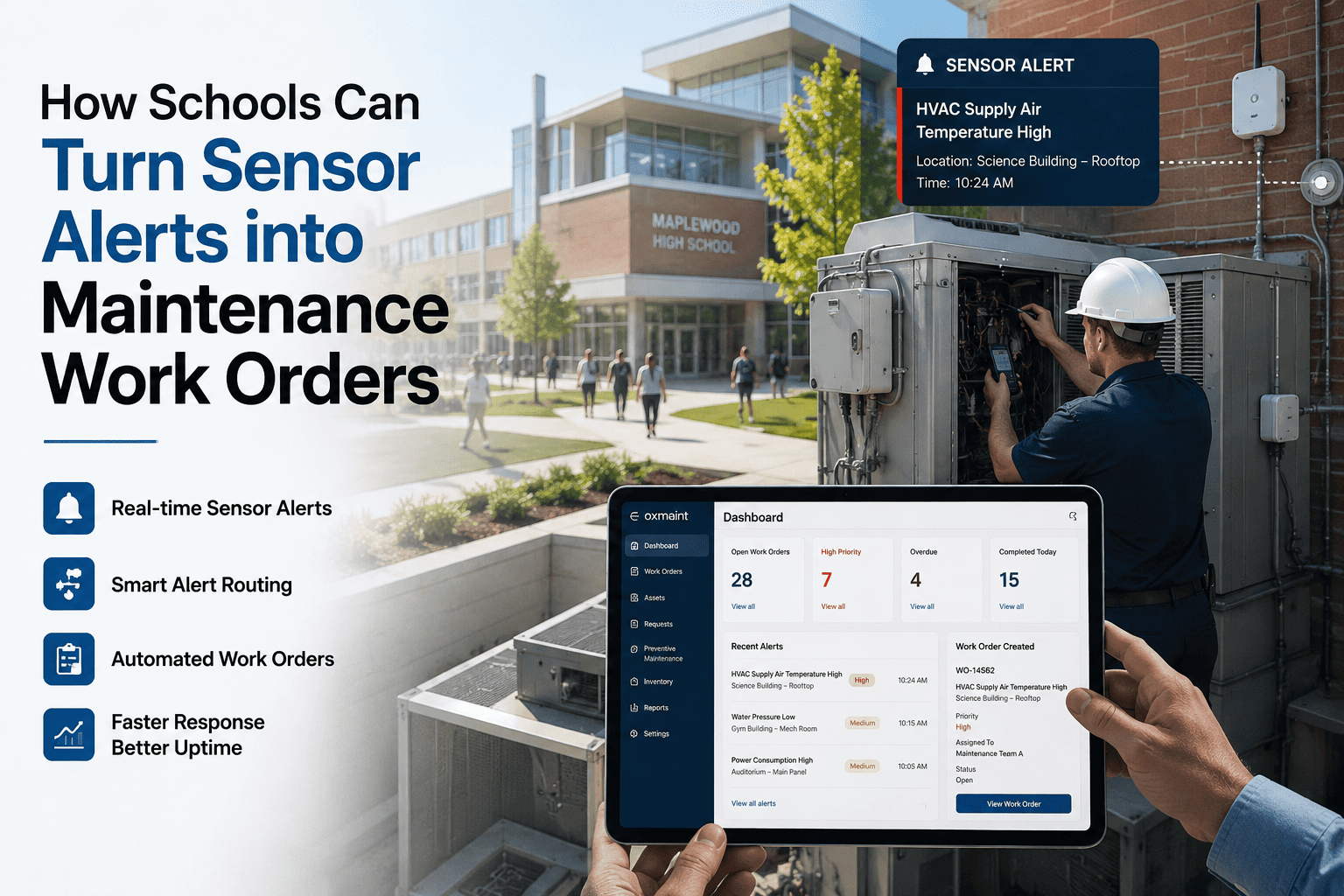
A 28-story commercial office tower's chiller plant failed on the hottest day of the year because a condenser tube bundle that had been scaling for 14 months finally blocked enough flow to trip the high-head-pressure safety. Emergency chiller rental and installation: $185,000 over 6 days. Tenant temperature complaints hit 340 in 48 hours. Three lease renewals were withdrawn during the event. The same repair — a planned condenser cleaning during the shoulder season — would have cost $4,200 in 3 hours with zero tenant impact. The building automation system logged the condenser approach temperature widening for 14 months. Nobody connected the trend to a maintenance action because HVAC service records lived in a contractor's filing cabinet, the BAS sat on a separate network, and the property manager tracked work orders in a spreadsheet that had not been updated since February. HVAC maintenance is the single largest operating expense and the single largest source of tenant complaints in commercial buildings — and the gap between reactive and proactive HVAC service management is the difference between a $4,200 cleaning and a $185,000 emergency. Schedule a demo to see HVAC maintenance management with BAS integration and predictive analytics.
40%
Energy Share
HVAC systems consume 40% of total commercial building energy — the largest single expense
$185K
Emergency Cost
Average emergency chiller replacement vs. $4K planned condenser cleaning
25%
Energy Recovery
Reduction in HVAC energy consumption achievable with optimized PM schedules
14 mo
Avg. Warning
How long condenser scaling trends before catastrophic failure — time wasted without CMMS
Why HVAC Maintenance Demands a Dedicated Service Management System
HVAC systems are the most complex, most expensive, and most tenant-visible building systems — yet most commercial properties manage HVAC maintenance through a patchwork of contractor invoices, spreadsheet schedules, and BAS alarm logs that nobody reviews until something fails. A purpose-built HVAC CMMS connects equipment monitoring, preventive scheduling, contractor management, and energy analytics into a single platform where every refrigerant charge, filter change, and belt replacement is documented, tracked, and optimized. Sign up free and see how HVAC service management transforms building comfort and energy performance.
Assets: Centrifugal/screw chillers, cooling towers, boilers, primary and secondary pumps, heat exchangers, and VFDs.
Risk: Chiller failure in peak cooling costs $25K–$50K per day in emergency rental plus tenant disruption. Boiler tube failure in heating season risks building closure.
PM Focus: Condenser/evaporator tube cleaning, oil analysis, refrigerant charge verification, cooling tower treatment, and VFD parameter checks.
Assets: AHUs, RTUs, VAV boxes, fan coil units, ductwork, dampers, and economizers.
Risk: Filter neglect increases fan energy 15–20% and degrades IAQ. VAV actuator failure causes hot/cold calls that erode tenant satisfaction scores.
PM Focus: Filter replacement on differential pressure triggers, belt inspection, bearing lubrication, damper actuator testing, and economizer calibration.
Assets: BAS controllers, sensors, thermostats, actuators, and network infrastructure.
Risk: A single failed zone sensor can cause simultaneous heating and cooling — wasting 30%+ energy in the affected zone with zero occupant awareness.
PM Focus: Sensor calibration verification, controller firmware updates, network health checks, and setpoint optimization audits.
Assets: Refrigerant circuits, leak detection systems, EPA Section 608 tracking, and refrigerant management documentation.
Risk: Unreported refrigerant leaks above threshold trigger EPA fines of $44,539 per day per violation. R-22 phase-out increases replacement costs to $50–$150 per pound.
PM Focus: Leak rate calculation, refrigerant charge documentation, technician certification tracking, and EPA reporting compliance.
The HVAC Service Failure Impact Matrix
Chiller Compressor Failure
Emergency: $80K–$250K
Planned rebuild: $15K–$40K | AI warning: 30–90 days
Cooling Tower Motor/Fan
Emergency: $25K–$60K
Planned swap: $5K–$12K | AI warning: 21–45 days
Boiler Tube Failure
Emergency: $50K–$150K
Planned tube replacement: $8K–$20K | AI warning: 14–30 days
One Prevented Chiller Failure Pays for 5 Years of CMMS. OxMaint monitors chillers, boilers, AHUs, and every HVAC component — generating predictive work orders weeks before failure so repairs happen during shoulder seasons, not peak demand.
Start Free Trial
The HVAC Preventive Maintenance Lifecycle
01
Seasonal Prep
Pre-cooling and pre-heating season PM packages auto-generate 6–8 weeks before demand. Chiller startup, boiler firing, and cooling tower commissioning checklists deploy to field technicians.
02
Condition Monitoring
BAS data feeds track approach temperatures, discharge pressures, zone temperature variance, and energy intensity. AI detects degradation patterns weeks before alarms trigger.
03
Usage-Based PM
Filter changes triggered by differential pressure — not calendar dates. Belt and bearing PM triggered by runtime hours. Refrigerant checks triggered by subcooling/superheat variance.
04
Contractor Coordination
HVAC contractor work orders include scope, certifications required, insurance verification, and performance documentation. Contractors close work orders with readings and photos on-site.
05
Energy Optimization
Post-PM energy baseline comparison confirms that maintenance actions delivered measurable efficiency improvement. Equipment trending feeds capital replacement planning.
HVAC Compliance and Regulatory Tracking
HVAC systems carry regulatory obligations that most building managers track manually — until an EPA auditor, fire marshal, or insurance underwriter requests documentation. Book a demo to see HVAC compliance tracking with automated deadline escalation.
EPA Section 608
Refrigerant leak rate tracking, technician certification verification, and annual reporting for systems containing 50+ lbs of refrigerant.
ASHRAE 62.1
Ventilation rate verification, outdoor air monitoring, and filter maintenance documentation required for IAQ compliance.
NFPA / Fire Code
Fire damper inspection, smoke detector testing in ductwork, and kitchen exhaust system maintenance per NFPA 96.
OSHA / Safety
Confined space permits for mechanical rooms, LOTO procedures for HVAC equipment, and refrigerant handling safety documentation.
Financial Impact for HVAC Service Operations
Emergency HVAC repair avoidance from predictive and preventive scheduling
Energy cost reduction from timely HVAC PM and controls optimization
Tenant retention value from maintaining comfort SLAs above 95%
Asset life extension — 25–35% longer HVAC equipment lifespan with consistent PM
30-Day Deployment for HVAC Service Management
Week 1
HVAC Asset Registry
- Import all HVAC equipment with nameplate data, refrigerant type, and age
- Apply criticality ratings by tenant impact and replacement cost
- Configure contractor profiles with trade certifications and insurance
- Load seasonal PM templates for cooling and heating startup
Week 2
Scheduling and Mobile
- Activate PM schedules with condition-based triggers from BAS data
- Deploy mobile work orders to in-house and contractor technicians
- Enable tenant comfort request portal with auto-classification
- Link parts inventory for filters, belts, refrigerant, and critical spares
Weeks 3–4
Intelligence and Optimization
- Activate predictive models on chillers, boilers, and cooling towers
- Configure energy baseline tracking per HVAC system
- Enable EPA refrigerant compliance tracking and reporting
- Deploy HVAC performance dashboards for property management
By day 30, every HVAC asset from chiller plant to zone-level VAV is on a documented service schedule, BAS data feeds predictive work orders, and every contractor visit produces audit-ready documentation. Start your free trial and have your HVAC equipment hierarchy loaded within the first week.
Your HVAC System Runs 8,760 Hours a Year. Manage Every One.
OxMaint gives HVAC service teams the seasonal scheduling, BAS integration, contractor coordination, and energy analytics to keep every building comfortable, efficient, and compliant — so tenant complaints drop, energy bills shrink, and equipment lasts decades longer.
Frequently Asked Questions
Can OxMaint integrate with our building automation system?
Yes. OxMaint connects to major BAS platforms — Siemens, JCI/Metasys, Honeywell, Tridium/Niagara, and Schneider Electric — via BACnet/IP, Modbus, and API. When BAS data detects conditions outside defined thresholds (approach temperature, discharge pressure, zone deviation), the CMMS auto-generates a work order with the specific equipment, condition, and recommended action.
How does the system handle both in-house and contractor HVAC service?
In-house technicians and external HVAC contractors work on the same platform with separate access levels. Contractor work orders include scope, required certifications, insurance verification, and mandatory documentation fields. Contractors close work orders on-site with readings, photos, and refrigerant logs — eliminating the "waiting for the contractor's report" delay that most properties experience.
Does the CMMS track EPA refrigerant compliance?
Every refrigerant addition and recovery is logged with quantity, technician certification number, and equipment identification. The system calculates annualized leak rates per circuit and alerts when approaching the EPA Section 608 threshold. One-click reports generate the documentation required for EPA compliance audits.
Can we track HVAC energy performance alongside maintenance?
OxMaint correlates maintenance actions with energy consumption data to quantify the efficiency impact of every PM. When a chiller condenser cleaning reduces kW/ton by 12%, the system documents that energy savings alongside the maintenance cost — providing the ROI data that property managers and owners need to justify maintenance budgets.
What is the realistic ROI for HVAC service management software?
ROI is immediate from the first prevented emergency. A single avoided chiller failure ($80K–$250K) exceeds years of platform cost. A 200K–2M sq ft commercial property typically documents $1.6M+ in annual value from emergency avoidance, energy reduction, tenant retention, and asset life extension.
Start free and calculate your building's HVAC maintenance ROI.