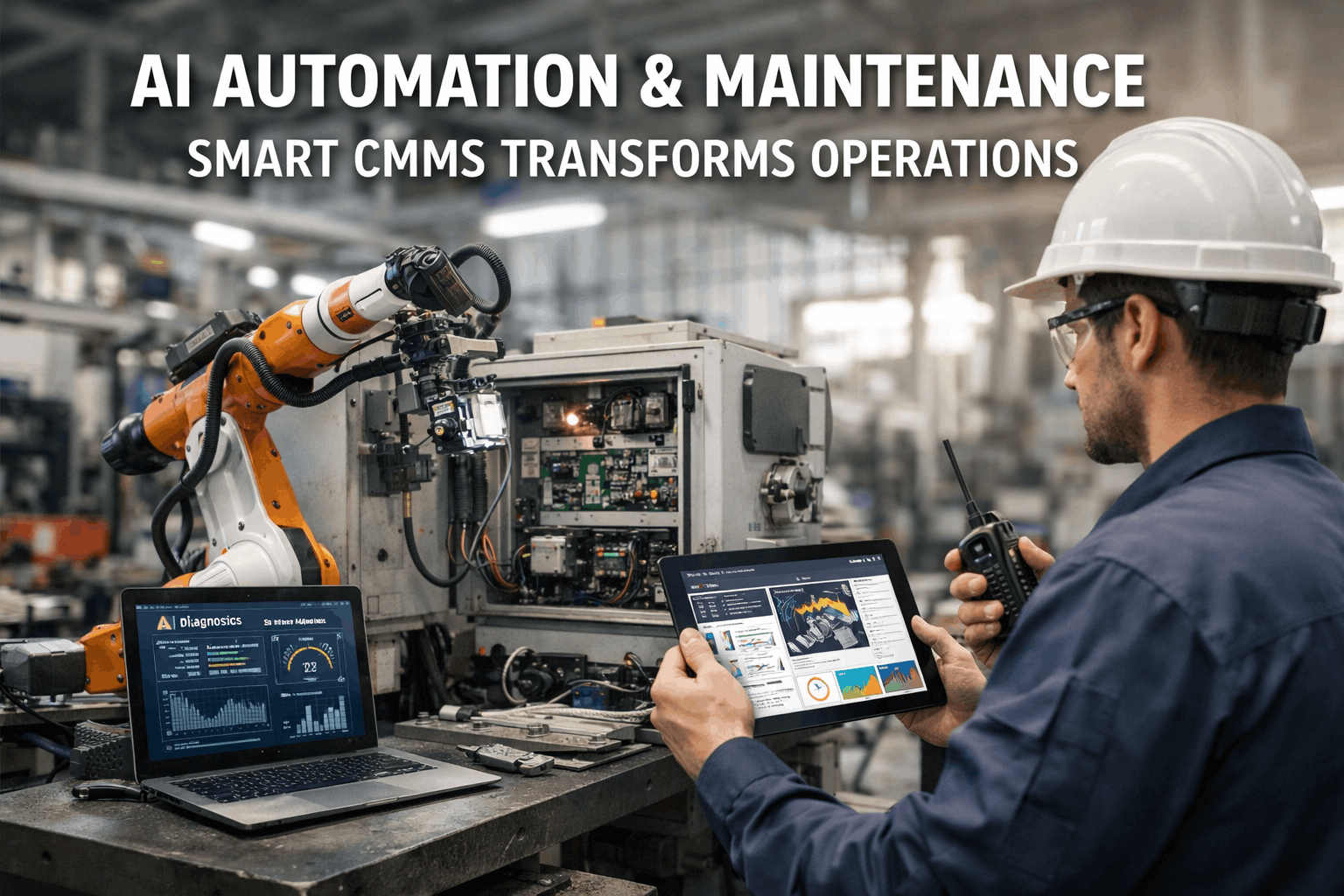
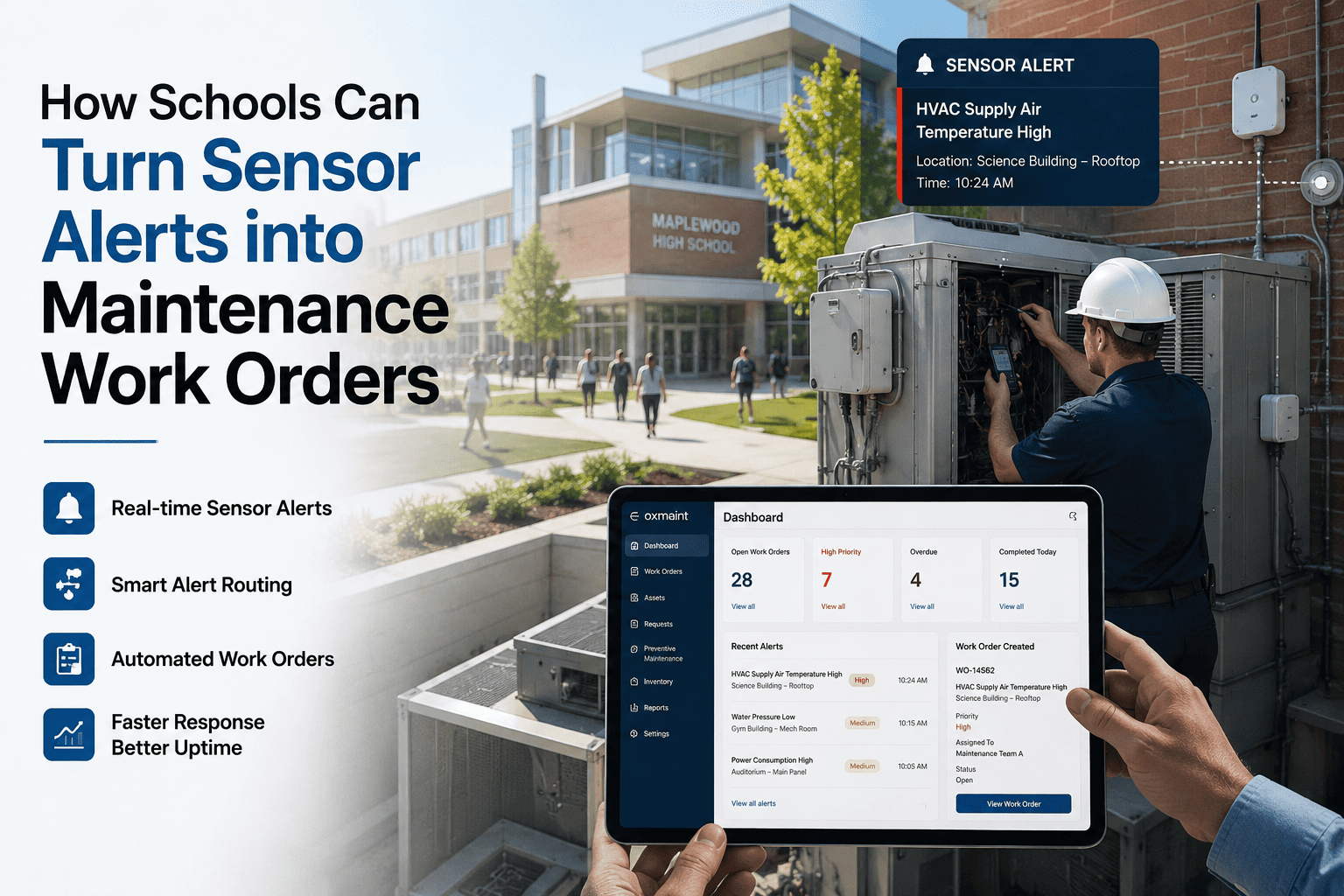
When a maintenance director is asked, "Why are our emergency repair costs still climbing despite our digital transition?" and the reply is, "We have the data, but our systems don't talk to each other," the promise of Industry 4.0 is left unfulfilled. Implementing a CMMS generates data; integrating AI and automation into that CMMS generates intelligence. The shift from manual entry to automated work orders and AI-driven predictive insights is the difference between being reactive and being proactive. By connecting real-time sensor data to automated scheduling, organizations stop fighting fires and start optimizing assets. If your maintenance strategy still relies on human memory or static spreadsheets, you are missing the single largest efficiency gain available in modern operations. Talk to our team about integrating AI and automation into your maintenance programme today.
Smart Maintenance Guide — 2026 Edition
AI and Automation in Maintenance: How Smart CMMS Transforms Operations
Automated work orders, predictive failure modeling, and intelligent resource scheduling—all powered by AI to ensure maximum uptime and operational excellence.
Reduction in overall maintenance costs through AI-driven predictive intervention
70%
Decrease in manual data entry time via automated work order generation
45%
Improvement in asset lifespan by eliminating "run-to-fail" cycles through smart monitoring
2.5x
Increase in technician productivity using AI-optimized routing and scheduling
Why AI and Automation are the Backbone of Modern CMMS
The traditional CMMS was a digital filing cabinet for work orders. A Smart CMMS, however, acts as the "brain" of the maintenance department. By leveraging Artificial Intelligence and machine learning, the system doesn't just record what happened; it predicts what will happen. Automation removes the friction of human intervention, ensuring that when a sensor detects an anomaly, a work order is created, parts are reserved, and a technician is notified—all in milliseconds. Without this integration, data is just noise; with it, data becomes a strategic asset that drives the bottom line.
Core Benefits of AI-Powered Maintenance
Predictive Failure Analysis
AI algorithms analyze vibration, temperature, and usage patterns to identify failure signatures weeks before they occur, allowing for scheduled repairs during planned downtime.
Automated Workflows
Trigger work orders automatically based on IoT sensor thresholds or meter readings, eliminating the lag time between fault detection and maintenance response.
Dynamic Scheduling
AI balances technician availability, skill sets, and asset priority to create the most efficient daily schedule, reducing travel time and maximizing "wrench time."
Smart Inventory Optimization
Automated stock tracking and AI demand forecasting ensure critical spares are always available without tying up excessive capital in overstock.
Automated Compliance
Generate audit-ready reports and compliance documentation automatically, ensuring that safety checks and regulatory inspections are never missed.
Root Cause Insight
AI digests years of historical data to correlate failures with environmental factors or specific operating conditions, providing technicians with instant troubleshooting guides.
The Technology Stack: Components of an AI-Driven Maintenance System
Transitioning to a smart maintenance model requires a cohesive technology stack. It isn't just about software; it's about the synergy between hardware (IoT sensors), connectivity, and the AI engine. Understanding the investment required in each layer helps organizations build a realistic roadmap for digital transformation. Book a demo to see how these components work together in the OxMaint ecosystem.
Investment Layers for AI Maintenance Automation
IoT & Sensor Hardware
Wireless Vibration Sensors$150–$400/ea
Thermal/Acoustic Imaging$1k–$5k/line
PLC Integration Gateways$500–$2k/ea
Requirement: Continuous data streaming for real-time AI modeling
Foundation: The "eyes and ears" of the smart system
AI Engine & Analytics
Predictive Failure ModelsIncluded in SaaS
Anomaly Detection AlgorithmsSaaS Subscription
Natural Language ProcessingSmart Search
Requirement: Large historical datasets for maximum model accuracy
Intelligence: The "brain" that deciphers complex patterns
Automation Workflows
Auto-Triggered Work OrdersLow Effort
Inventory Reorder TriggersMedium Effort
Mobile Notification EngineInstant
Requirement: Deep integration between CMMS and ERP/Purchasing
Execution: The "hands" that perform manual tasks digitally
Move Beyond Spreadsheets to an AI-Powered Future
OxMaint centralizes your IoT data, automates your scheduling, and provides AI-driven failure predictions in one intuitive platform. Stop reacting to breakdowns and start predicting them with the industry's most advanced smart CMMS.
Where does your organization stand on the path to total maintenance automation? Use this maturity scale to identify your current state and define the necessary steps to reach Level 5. Most organizations currently operate at Level 2, missing out on the exponential returns of predictive and prescriptive maintenance. Start your free trial to begin your ascent.
The Path to Autonomous Maintenance
5
Prescriptive — Self-Optimizing Maintenance
AI not only predicts failure but prescribes the exact repair steps and automatically adjusts production schedules to accommodate maintenance. Minimal human administrative input required.
Action: Focus on continuous model training and fleet-wide optimization
Goal State
4
Predictive — Data-Driven Proactivity
IoT sensors are fully integrated. AI models identify potential failures with >90% accuracy. Maintenance is performed based on asset condition rather than calendar dates.
Action: Integrate AI insights with financial and parts procurement systems
High Efficiency
3
Automated — Condition-Based Alerts
Work orders are automatically triggered by meter readings or sensor thresholds. Technicians receive alerts on mobile devices. Data entry is significantly reduced.
Action: Deploy AI analytics to move from thresholds to pattern recognition
Standard
2
Digital — Reactive & Basic Preventive
Maintenance is tracked in a basic CMMS. Work orders are digital but manually created. Preventive maintenance (PM) is based on simple calendar time-blocks.
Action: Implement IoT sensors and automated workflow triggers
Beginner
1
Manual — Paper & Excel Dependency
Maintenance is purely reactive. Records are kept on whiteboards or paper. No clear visibility into asset history or maintenance costs. High risk of catastrophic failure.
Action: Digitization of assets and historical data in a CMMS
High Risk
Financial Impact: The Cost of Delaying AI Integration
The ROI of AI maintenance isn't just about saving on parts; it's about the massive cost avoidance associated with downtime. In high-output environments, the cost of a single hour of unplanned downtime can exceed the annual cost of an AI-powered CMMS. As the delay between a fault and its repair increases, the cost escalates exponentially. AI and automation collapse this timeline.
The Downward Spiral: Cost of Maintenance Delay
How AI intervention at the "P" (Potential Failure) point saves thousands compared to the "F" (Functional Failure) point
5 AI Prediction (P)
$500 (Minor Adjustment)
1x
4 Automated Alert
$1,500 (Standard Repair)
3x
3 Operator Notice
$7,500 (Part Replacement)
15x
2 Visual Smoke/Noise
$25,000 (Major Overhaul)
50x
1 Catastrophic Failure (F)
$100k+ (Asset Loss/Downtime)
200x
AI shifts your maintenance from Level 1 & 2 (Reactive) to Level 4 & 5 (Proactive). The investment in Smart CMMS is typically recouped by preventing a single "Level 1" failure event.
Automate Today for a Maintenance-Free Tomorrow
OxMaint gives you the tools to automate mundane tasks and unlock deep AI insights. Let our platform handle the scheduling and predictions so your team can focus on high-value optimization.
Roadmap: 5 Steps to AI-Powered Maintenance Success
Implementing AI and automation is a journey, not a switch. Successful organizations follow a structured path that builds the data foundation first before layering on complex analytics. By focusing on quick wins—like automated work order generation—maintenance teams gain the momentum needed for a full-scale AI transition.
The Smart Maintenance Deployment Cycle
1
Digital Asset Baseline & Meter Tagging
Clean your asset data. Every critical machine must be tagged with unique IDs and linked to meter readings or digital twins. Establish the "source of truth" for all asset history.
Month 1
2
IoT Sensor Deployment & Connectivity
Install sensors on critical assets (motors, pumps, gearboxes). Connect these sensors to your CMMS via API or gateway to begin the continuous flow of condition data.
Months 2–3
3
Workflow Automation & Rule Setting
Set the rules. When vibration exceeds X, create a work order of type Y and assign to team Z. Automate the low-level administrative tasks to free up supervisor time.
Months 4–5
4
AI Model Training & Pilot Predictive Runs
Allow the AI to analyze historical failure data alongside new sensor data. Start with a "pilot" group of assets to refine failure signatures and improve prediction accuracy.
Months 6–9
5
Prescriptive Expansion & Full Integration
Scale the predictive models across all facilities. Integrate with ERP for "just-in-time" parts ordering based on AI-predicted failure dates. Achieve a self-optimizing state.
Year 1+
Expert Insight: The Human Side of Maintenance AI
"
The biggest misconception about AI in maintenance is that it replaces the technician. In reality, it empowers them. Our team used to spend 40% of their day filling out forms and 20% searching for manuals. With OxMaint’s AI-driven platform, the work order finds the technician, provides the diagnostic code, and attaches the manual automatically. Our guys aren't data entry clerks anymore; they are highly skilled specialists solving problems before the production line even knows they exist. The morale shift has been as significant as the cost savings.
— Director of Reliability, Global Automotive Supplier
95%
Technician adoption rate within first 60 days of deployment
3 hrs
Average time saved per technician, per week on administration
40%
Reduction in 'unclear' work order descriptions via AI cleanup
The transition to AI and automation in maintenance is no longer a luxury; it is a prerequisite for competitiveness in 2026 and beyond. Organizations that embrace a smart CMMS will see their maintenance departments evolve from cost centers to value drivers. By automating the routine and predicting the exceptional, you ensure that your most valuable assets—both machine and human—are always operating at peak performance. Start your AI maintenance journey today and see how smart technology can transform your operations.
Turn Your Maintenance Data into a Competitive Advantage
OxMaint is the bridge between raw industrial data and intelligent operational action. Experience the power of AI-automated work orders, predictive analytics, and smart resource management in one unified platform.
Does AI maintenance require specialized data scientists on my team?
No. Modern smart CMMS platforms like OxMaint are designed for maintenance professionals, not data scientists. The complex AI modeling happens "under the hood." Your team interacts with intuitive dashboards, automated alerts, and simplified reports. While having a reliability engineer is helpful for interpreting advanced trends, the system is built to be "plug-and-play" for the average maintenance technician.
How much historical data do I need to start using AI features?
While more data is always better, you don't need years of history to start. Basic automation (work order triggers) can start on Day 1. Simple anomaly detection can begin after just 2–4 weeks of baseline sensor data. More complex "Remaining Useful Life" (RUL) predictions typically require 3–6 months of data to reach peak accuracy. The system learns as it grows.
Is automation worth it for a small facility with limited assets?
Absolutely. In fact, automation is often more critical for small teams because it acts as a "force multiplier." If you only have two technicians, they cannot afford to spend hours on paperwork or chasing phantom alarms. Automated scheduling and mobile work orders ensure that your limited human resources are always focused on the most critical tasks.
What is the difference between "Predictive" and "Prescriptive" maintenance?
Predictive maintenance tells you *when* an asset is likely to fail (e.g., "This motor has a 90% chance of failing in the next 14 days"). Prescriptive maintenance takes it a step further by telling you *what* to do about it (e.g., "Bearing #3 is overheating; schedule a replacement during Tuesday's lunch break and order the part now"). Prescriptive is the pinnacle of the maintenance maturity model.
Can an AI CMMS integrate with my existing PLC or SCADA systems?
Yes. OxMaint uses open APIs and industrial protocols (like MQTT or OPC-UA) to pull data directly from your factory floor controllers. This allows the CMMS to see exactly what your machines are doing in real-time, enabling automated work order triggers based on actual runtime hours or fault codes generated by the equipment itself.